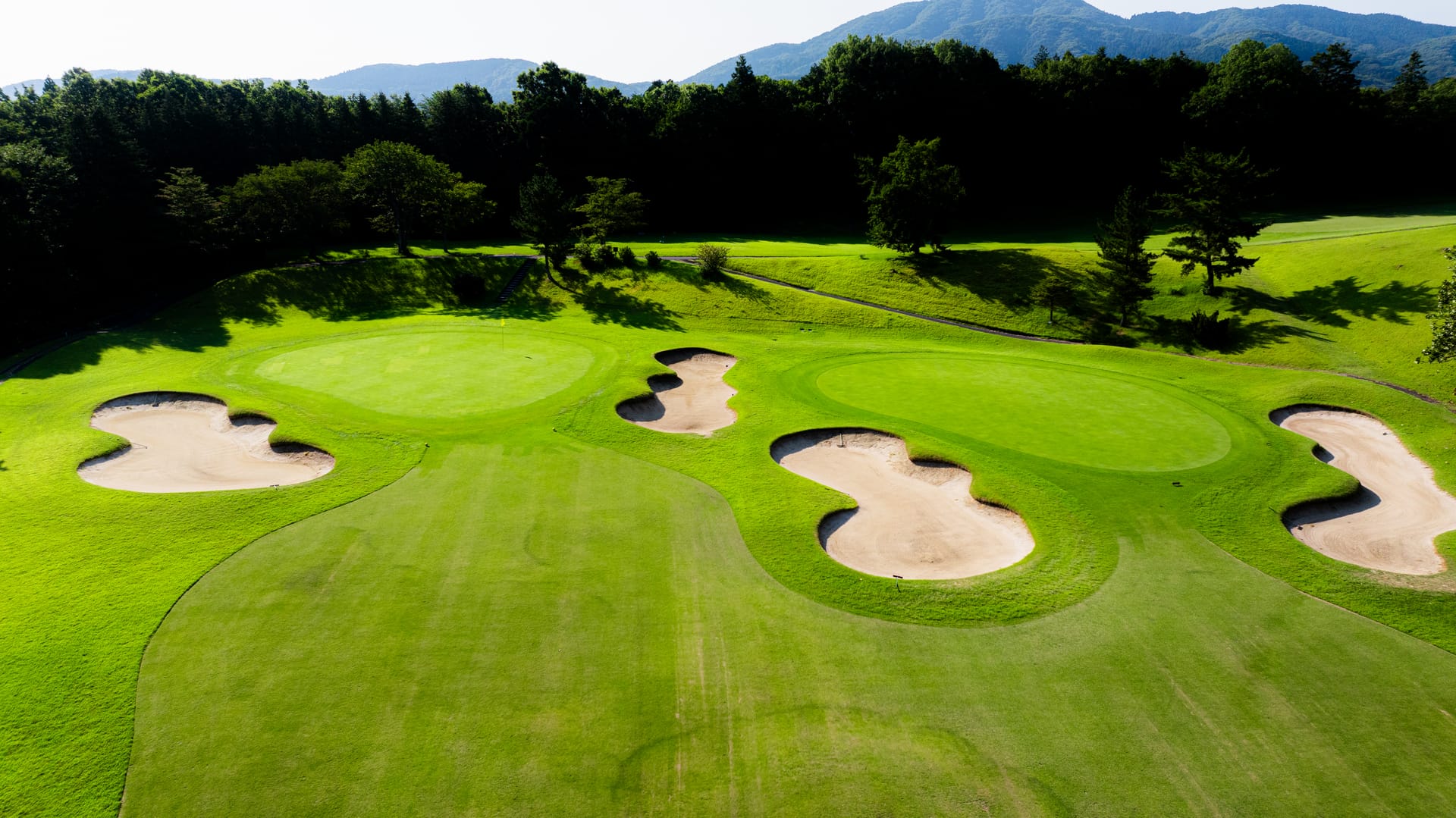
Why Do Japanese Golf Courses Have Two Greens?
By Elite Golf Japan · Published Nov 19, 2026 · Updated Nov 19, 2026
Quick answer
Many Japanese courses built two greens on each hole so they could use a heat-tolerant korai grass green in summer and a bentgrass green in cooler months. Only one is in play on a given day, and the club tells you which. If your ball finishes on the other one, the Rules of Golf say you must not play it from there: take free relief within one club-length of the nearest point of complete relief, no nearer the hole.
| Course | Nearest station | Weekday | Weekend |
|---|---|---|---|
| Nihon Cheung Kong Golf Club | Goi Station (JR Uchibo Line) | 7,500 | 13,000 |
Indicative green fees. Courses set their own prices, which vary by date.
Why do Japanese golf holes have two greens?
To use two grasses through the year. A two-grass course has a korai green, a heat-tolerant grass, beside a bentgrass green on each hole, and the club plays one green at a time.
Komagawa Country Club in Saitama shows the pattern. It opened in October 1972 with a bentgrass B green and a korai K green on every hole.
The system is still changing. Komagawa replaced its K green with A4 bentgrass in March 2003 and now plays two bentgrass greens. Shinshiro Country Club in Aichi went the other way: it converted one green on each hole to korai, citing record heat, and began using them on its East and North courses on August 4, 2025.
What do A, B and K green mean?
They are the names of the two greens, and each club chooses its own. At Komagawa, B was the bentgrass green and K the korai green, and the club still uses both names now that both greens are bentgrass.
Other clubs use other letters. Fuki Golf Club named its rebuilt main green, sown with Champion Dwarf bermudagrass, the “A green” from September 13, 2025, and used its sub green until then. Read your course’s scorecard rather than assuming a letter means a grass.
Yardages can differ by green. Our partner Nihon Cheung Kong Golf Club in Chiba has two greens on every hole, and its scorecard length from the Champion tees is given for the B green.
How do I know which green is in play?
The club tells you on the day. Some post it ahead: Kakegawa Green Hill Country Club in Shizuoka publishes a weekly table with AG or BG for each day, and its table for November 9 to 13, 2026 switches between the two.
At the course, check the starter’s board or ask at the front desk or the starter’s hut (マスター室) before you tee off. A caddie, if you have one, will point you to the right green.
| Label | Usually means | What to check |
|---|---|---|
| K or KG | Korai green at Komagawa when it opened | Whether it is still korai |
| B or BG | Bentgrass green at Komagawa | Which green the day’s yardages assume |
| A or AG | Fuki’s rebuilt bermudagrass main green, and one of Kakegawa Green Hill’s two greens | The club’s own naming, so read the scorecard |
| Sub green (サブグリーン) | The second green, which Fuki used while its main green was rebuilt | Whether the main green is closed |
What if my ball lands on the wrong green?
Take free relief. The other green on a two-green hole is a wrong green, and Rule 13.1f says you must not play a ball that touches it or lies inside its edge.
Find the nearest point of complete relief in the same area of the course where your ball came to rest. Drop within one club-length of that point, in that same area of the course and no nearer the hole, so that the wrong green no longer touches your ball, stance or swing. There is no penalty for taking relief.
Playing the ball from the wrong green is a breach of Rule 13.1f, and the R&A sets the penalty as the general penalty, two strokes in stroke play. The R&A’s rule finder shows the relief area in a diagram.
Do I get relief if the other green is only under my feet?
Under Rule 13.1f, yes. Relief covers a wrong green that interferes with your area of intended stance or swing, not only your ball. There is no relief if the interference exists only because you choose a clearly unreasonable club, stance or direction of play.
A course can change the stance part with a Local Rule, so read the back of the scorecard. If the card is only in Japanese, ask at the front desk before you start.
How can Elite Golf Japan help?
We book tee times at Japanese courses, including two-green courses such as Nihon Cheung Kong. Send your dates and group size, and we reply within 12 business hours (JST 9:00–18:00). We can request a tee time, but we cannot guarantee one.
Our booking fee is US$60 for a solo golfer, US$90 for two or three, US$120 for a foursome, and US$30 per golfer for groups of five or more, charged only once a tee time is confirmed. Green fees are paid at the course. Cancel 10 or more days before play and the booking fee is refunded in full. For the rest of the day at a Japanese club, from check-in to the bath, see our etiquette guide.
Common questions
Why do Japanese golf courses have two greens?
So a course can switch grasses with the seasons. Komagawa Country Club in Saitama, for example, opened in 1972 with a bentgrass B green and a korai K green on each hole. Korai copes with summer heat, which is the reason Shinshiro Country Club gave for converting one green per hole to korai in 2025.
What do A green, B green and K green mean?
They name the two greens on a hole, and each club picks its own letters. At Komagawa Country Club, B was the bentgrass green and K the korai green, and it kept those names after both became bentgrass. Kakegawa Green Hill Country Club in Shizuoka posts a weekly table showing AG or BG for each day.
What happens if my ball lands on the wrong green?
You must take free relief. Under Rule 13.1f you must not play the ball as it lies; drop it within one club-length of the nearest point of complete relief, in the same area of the course and no nearer the hole. Playing it from the wrong green is a breach that carries the general penalty, two strokes in stroke play.
Do I get relief if the other green is only in my stance?
Under Rule 13.1f, yes, because relief covers a wrong green that interferes with your intended stance or swing. A course can change this with a Local Rule, so check the scorecard or ask at the front desk.
Do two-green courses change their grasses?
Yes, and not always in the same direction. Komagawa replaced its korai K green with A4 bentgrass in 2003 and now runs two bentgrass greens. Shinshiro Country Club in Aichi converted one green on each hole to korai, citing record summer heat, with its East and North courses using them from August 4, 2025.
Related guides
Sources
- R&A: Rules of Golf, Rule 13 (putting greens) (checked Nov 12, 2026)
- R&A: Players' Rule Finder, relief from wrong green (checked Nov 12, 2026)
- Komagawa Country Club: course guide (checked Nov 12, 2026)
- Shinshiro Country Club (PGM): korai green notice (checked Nov 12, 2026)
- Fuki Golf Club (PGM): green change notice (checked Nov 12, 2026)
- Kakegawa Green Hill Country Club: weekly green in use (checked Nov 12, 2026)